Heart attacks, also referred to as cardiovascular disease (CVD), are now one of the leading causes of death for people worldwide in modern times. An increasing number of Indians, even among the adolescent and young age groups are prone to heart attacks due to their health damaging modern lifestyle (Toshi, 2021). Cardiovascular disease has also become the most important cause of premature death and disability in the population, especially at a productive young age, especially in adolescents (Kalra et al, 2023). Of the 57 million deaths due to non-communicable diseases in 2016, CVDrelated deaths accounted for about 17.9 million (44%) deaths, and also these diseases affect the most productive population. This shows an increasing trend in death due to CVDs over the years and is expected to rise sharply by 2030 (WHO, 2023).
In India, CVD accounted for 27 percent (n=1,61,865) of the total number of deaths of 599,500 due to non-communicable diseases. The mortality rates had a slight male preponderance and are expected to increase in the coming years (Kumar & Sinha, 2020). Sedentary lifestyles and work habits are to blame for the sharp rise in cardiac arrest rates among Indians, particularly in the youth demographic. It was estimated that 53 percent of Indians between the ages of 26 and 40 were at risk for cardiovascular disease (CVD) as a result of the dual problems of obesity and hypertension, which can lead to CVD (Goel, 2022).
George et al (2025) studied rural adolescent subjects in Kerala, obesity and overweight prevalence rates were 16.0 and 7.0 percent, respectively. Kerala leads the world in the severity of heart disease with 19.90 percent of people at great risk of developing heart disease. In 25 years (from 1993), the number of Keralites suffering from heart disease rose from 1.4 percent to 19.9 percent. Men are more likely than women (15%) to have the disorder (32%) (Thayil, 2022).
Artificial Intelligence (AI) in Machine learning (ML) models have proven to be very useful predictors in the cardiovascular system studies. They are better at capturing the intricate relationships and non-linear connections that exist between the variables and the outcomes than standard statistical models. Based on multiple studies, it was determined that support vector machines (SVM) and random forests (RF) outperformed conventional models (Alaa et al, 2019). Nursing, the foundation of healthcare requires high degree of AI application; it is a small step by the investigators to prepare nurses for applying and understanding this transformation technology in the field of nursing and health care (Bajwa et al, 2021). However, this technology is in nascent stage in the nursing domain. Limited studies have been conducted to find out the cardiovascular health risk among adolescents specifically in Kerala.
Objectives
This study sought to (1) identify and explore the cardiovascular health risk among adolescents, and (2) develop a nursing algorithm driven by artificial intelligence for early detection of cardiovascular health risk in adolescents.
Materials and Methods
The present study adopted a prospective crosssectional descriptive design. Study samples were drawn from collegiate late adolescents of all genders, aged 17 to 19 yeas in three Northern districts of Kerala viz. Kannur, Kasaragod, and Wayanad. Multistage cluster sampling technique was used. A total of 1240 students were recruited for the study.
Instrument for the study were:
(a) Adolescents’ Biosocial data schedule;
(b) Adolescents' Cardiovascular Health Risk Assessment including International Physical Activity Questionnaire (IPAQ); Modified Metagenics - Cardiovascular Risk Assessment Questionnaire; and Modified WHO STEPS Instrument for Tobacco and Substance Use.
Deployment of Machine Learning algorithmRandom Forest Classifier Data collection procedure:
After ethical clearance from the Institutional Ethics Committee, data collection permission was obtained in multicentres. Informed consent was obtained from the participants.
Adolescent Cardiovascular Health Risk Assessment tool was administered based on an Interview method, and the responses were recorded in a data sheet with a code identifier by the field investigator. The time duration taken for the collection of data from each sample was 20 to 30 minutes. No ethical issues involved; privacy, right to participation or withdraw, and dignity of the samples were protected throughout the study.
Results & Discussion
The Demographic Results
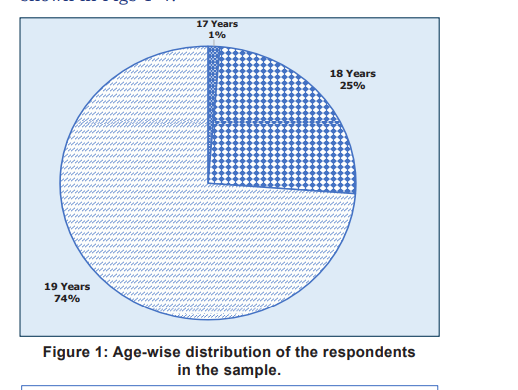
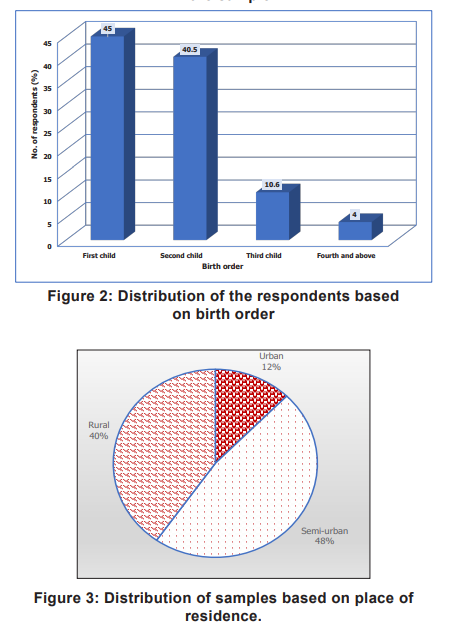
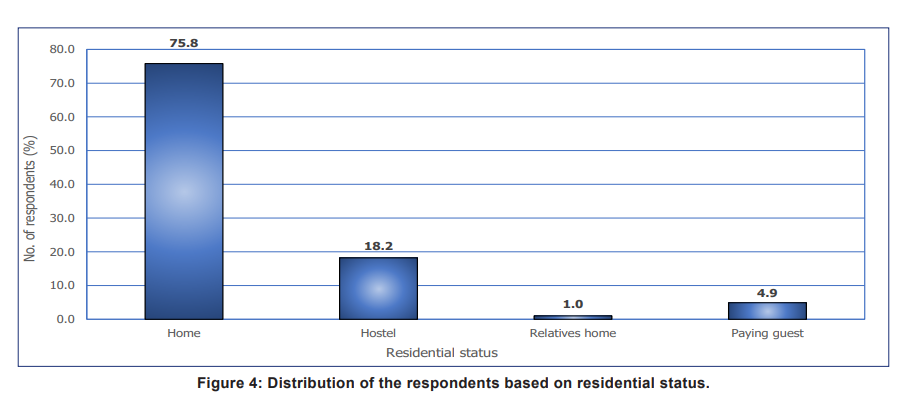
The demographic profile of 1,240 adolescents is shown in Figs 1-4.
The Cardiometabolic Profile of the Adolescents
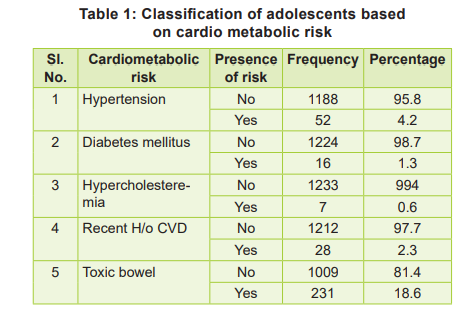
After the study assessment of the cardiometabolic profile of adolescents, the results are outlined in Table 1.
Ekta & Tulika (2016) found that girls were more likely than boys to have excessive triglyceride levels and hypercholesterolemia. The results of the hypertension risk analysis were consistent with the research conducted by Fikriana et al (2020), which revealed that 3.2 percent of adolescents had hypertension.
Cardiovascular Health Risk Factors among Adolescents
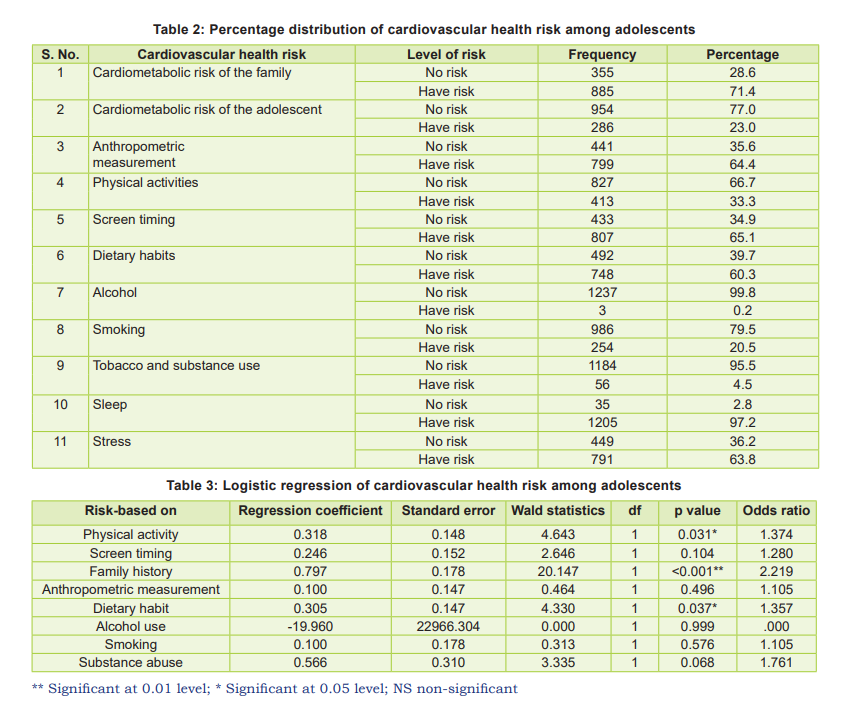
The results of assessment of the Cardiovascular Health risk factors among adolescents are shown in Table 2.
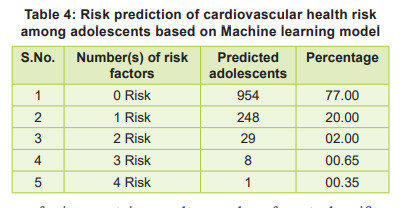
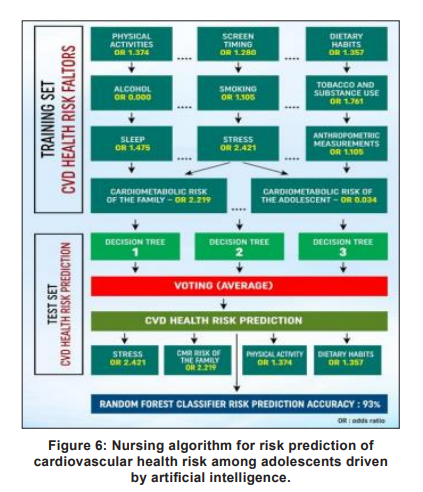
Table 3 shows that odds ratio of a family history of CVD was 2.219 (0.797- 20.147, p< 0.001), physical activity was 1.374 (0.318-0.4.643, p<0.05), dietary habits was 1.357 (0.305- 4.330, p<0.05) and stress was 2.421 (0.884-29.140, p<0.001) times more likely to exhibit CVD than those having no risk. These results differed from those of Guthold et al (2019), who, in their firstever finding of insufficient physical activity noticed that 72 percent of adolescents in India had the lowest levels of insufficient physical activity. Further, Sindhu et al (2020) also reported low physical activities (72.1%) among 1030 grade 9 and 10 students.
In terms of Screen Timing, our findings are nearly in tune with those of Natarajan et al (2020) who reported that 425 (77%) of the adolescents were using screens for pleasure for two or more hours a day. This is in line with of BMJ Global Health (2024) report that 56 percent of the disease burden in India is due to unhealthy diets. Similar results were stated by Natarajan et al (2022), who found that 5 (1%) and 15 (3%) of the respondents, respectively, reported habitual consumption of alcohol and smoking tobacco. In a different survey, Ekta & Tulika (2016) found that whereas 11.9 percent boys and 1 percent of girls reported ever using alcohol, 32.3 percent of boys and 6.6 percent of girls reported ever using tobacco.
AI-based Algorithm for Identifying Cardiovascular Health Risk Factors among Adolescents
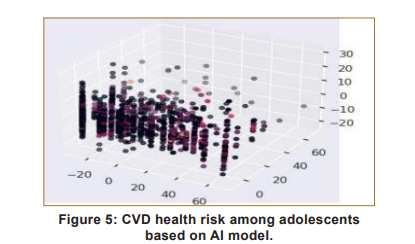
The study deployed an AI-based machine learning algorithm, such as 1. Logistic regression model, 2. Decision tree classifier, 3. Support vector classification, 4. K Neighbours classifier, 5. Random Forest classifier for identifying cardiovascular health risk factors among adolescents (prediction results are in Table 4, Fig 5).
The accuracy of the predictions varied among different algorithms and found unbalanced data sets; hence, a confusion matrix was applied to find the most accurate model. Out of 5 models, the
confusion matrix results random forest classifier of predicted 248 cases representing multi classes, and the results showed 93 percent accuracy, 95 percent sensitivity, 74 percent precision, and an F1 score of 83.1 percent. Hence it is concluded that the Random Forest Classifier model was the most suitable machine Learning model in AI for the prediction of cardiovascular health risk among adolescents’ prospective data sets in Kerala.
The application of Machine learning model findings parallels the study conducted by Alamuri et al (2024), which reported that the classifier with the highest accuracy was the logistic regression classifier. The observed results, which include F-measure (85.71%), recall (81.82%), accuracy (88.16%), and precision (90%), indicate
encouraging outcomes for the development of heart disease prediction
Developing a Nursing Algorithm Driven by Artificial Intelligence for Early Detection of Cardiovascular Disease among Adolescents
In this proof-of-concept, the present study identified the Random Forest Classifier model as the most suitable machine learning model (93%) in AI prediction of cardiovascular health risk data sets specific to adolescents in the Indian context. Therefore, this model (Fig 6) is suggested for the development of a Nursing algorithm driven by the Random Forest Classification for the prediction of cardiovascular health risks among adolescents. Its implementation would facilitate early detection and primordial prevention opportunities. Studies on large cohorts shall further validate the success of the proposed framework.
Conclusion
The main purpose of this study was to assess the capability of risk factors to be used in cardiovascular predictive machine learning models and to develop a nursing algorithm. The collected data regarding cardiovascular risk factors among 1240 adolescents from three districts of Northern Kerala was carried out in a statistical analysis. Results show that family history of CVD, Physical activity, Dietary habits, and Stress, are inferred as major risk factors for CVD among adolescents. The major nursing implications is that the further research on large cohorts is necessary to determine the successful validation of the developed nursing algorithm for the detection of cardiovascular health risks among adolescents.
Acknowledgement:
The authors thank all the adolescents’ participants and their Institutional heads for granting permission for conduct of this study.
References
1. Toshi DN. Why Are Heart Attacks Becoming Common Among The Youth? Pharm Easy Blog 2021, September 8. https://pharmeasy.in/ blog/why-are-heart-attacks-becoming common-among-the-youthzydus/
2. Alaa AM, Bolton T, Di Angelantonio E, Rudd JHF, van der Schaar M. Cardiovascular disease risk prediction using automated machine learning: A prospective study of 423,604 UK Biobank participants. PLOS ONE 2019; 14 (5): e0213653 https://doi.org/10.1371/journal. pone.0213653
3. Bajwa J, Munir U, Nori A, Williams B. Artificial intelligence in healthcare: Transforming the practice of medicine. Future Healthcare Journal 2021; 8 (2): e188–94. NCBI. https://doi. org/10.7861/fhj.2021-0095
4. BMJ Global Health. Obesity, fatty foods threat to healthy and wealthy India. The Times of India, 23 July 2024
5. Alamuri Dheeraj, Singh KB, Agrawal DK. Cardiovascular Health Prognosis: Machine Learning Approaches for Precise Heart Disease Prediction. IEEE International Students’ Conference on Electrical, Electronics and Computer Science (SCEECS), Bhopal, India 2024. https://doi.org/10.1109/sceecs61402.2024.10482323
6. Ekta G, Tulika M. Risk factor distribution for cardiovascular diseases among high school boys and girls of urban Dibrugarh, Assam. Journal of Family Medicine & Primary Care 2016: 5(1): 108. https://doi.org/10.4103/2249-4863.184633
7. Fikriana Riza, Nursalam Nursalam, Devy SR, Ahsan, Afik Al. Risk factor of hypertension among adolescents: A literature review. Indian Journal of Public Health Research and Development. 2020; 11 (3): 1066-68
8. George Shiny, Binu Jeffy, Joseph BB. A study on the prevalence of overweight and obesity and its influencing factors in rural adolescent school going children in Kerala, India. International Journal of Current Res & Review 2025; 04 (24); 89-99
9. Natarajan V, Sekar T, Chockalingam P. Prevalence of cardiovascular health risk behaviours in college-going women in a major metropolis in India. Indian Heart Journal 2020; 72(5): 451-53. https://doi.org/10.1016/j.ihj.2020.08.014
10. Sindhu GS, Jamuna N, Ram Gopal CN. Exploration of the factors influencing healthrisk behaviors among school adolescents: A mixed method approach. TNNMC JPN 2020; 8 (1): 17-21
11. Smitha R, Anilkumar R. A study on the socio-economic statuses of students enrolling vocational higher secondary education in Kerala. International Journal of Innovative Science & Research Technology 2020; 5(11). ISSN 2456-2165 12. Kumar AS, Sinha N. Cardiovascular disease in India: A 360-degree overview Medical Journal Armed Forces India 2020; 76(1): 1-3. https://doi.org/10.1016/j.mjafi.2019.12.005
13. Thayil G. Why are heart diseases on the rise among youngsters in Kerala? Onmanorama 2022
14. World Health Organization. WHO steps surveillance manual: The WHO stepwise approach to chronic disease risk factor surveillance. WHO, 2025
15. World Health Organization. Adolescent health. World Health Organization 2023. https://www.who.int/health-topics/adolescenthealth#tab=tab_1

This work is licensed under a Creative Commons Attribution-NonCommercial-ShareAlike 4.0 International License.